Showing posts with label gardens. Show all posts

Monday, September 3, 2012

Monet - the Master of Impressionism

On a recent short trip to Paris, I spent a morning taking the train from the St. Lazare train station to the town of Vernon, about 45 miles southwest of Paris. Once there, a quick 10-minute bus ride took me to the sleepy little village of Giverny.


Just outside the village lay the Maison et Jardins de Claude Monet - the house and gardens of Claude Monet, the master of Impressionism.  Since Monet is one of my favorite artists, it was very exciting to be transported in time to a place where he lived and painted many of his great masterpieces.


Claude Monet lived in his home at Giverny for forty-three years, from 1883 to 1926. During this very long time, he layed out the house to his own tastes, adapting it to the needs of his family and professional life.  He loved the use of color and it was he that chose the pink color of the walls and the green shutters for the outside of the house.


Unfortunately, no photographs were allowed inside his homes so I'll give you a brief description here.   It was a very long house and decorated very simply but beautifully; many rooms painted in cheerful hues of blues and yellows.  The house was warm and welcoming and lived in fully by his family of ten.  The kitchen was especially inviting with blue walls, French tiles and an array of sparkling copper pots and pans hanging on the walls.  A doorway off the kitchen led into a wonderful yellow dining room that contained a country-sized eating table where his family and  guests were fed and entertained.  Claude's studio walls were covered with Japanese paintings, which he collected for 50 years.  Other walls bore paintings by the likes of his friends, Pizzarro, Cezanne, Renoir, Morisot, Manet, Sisley....


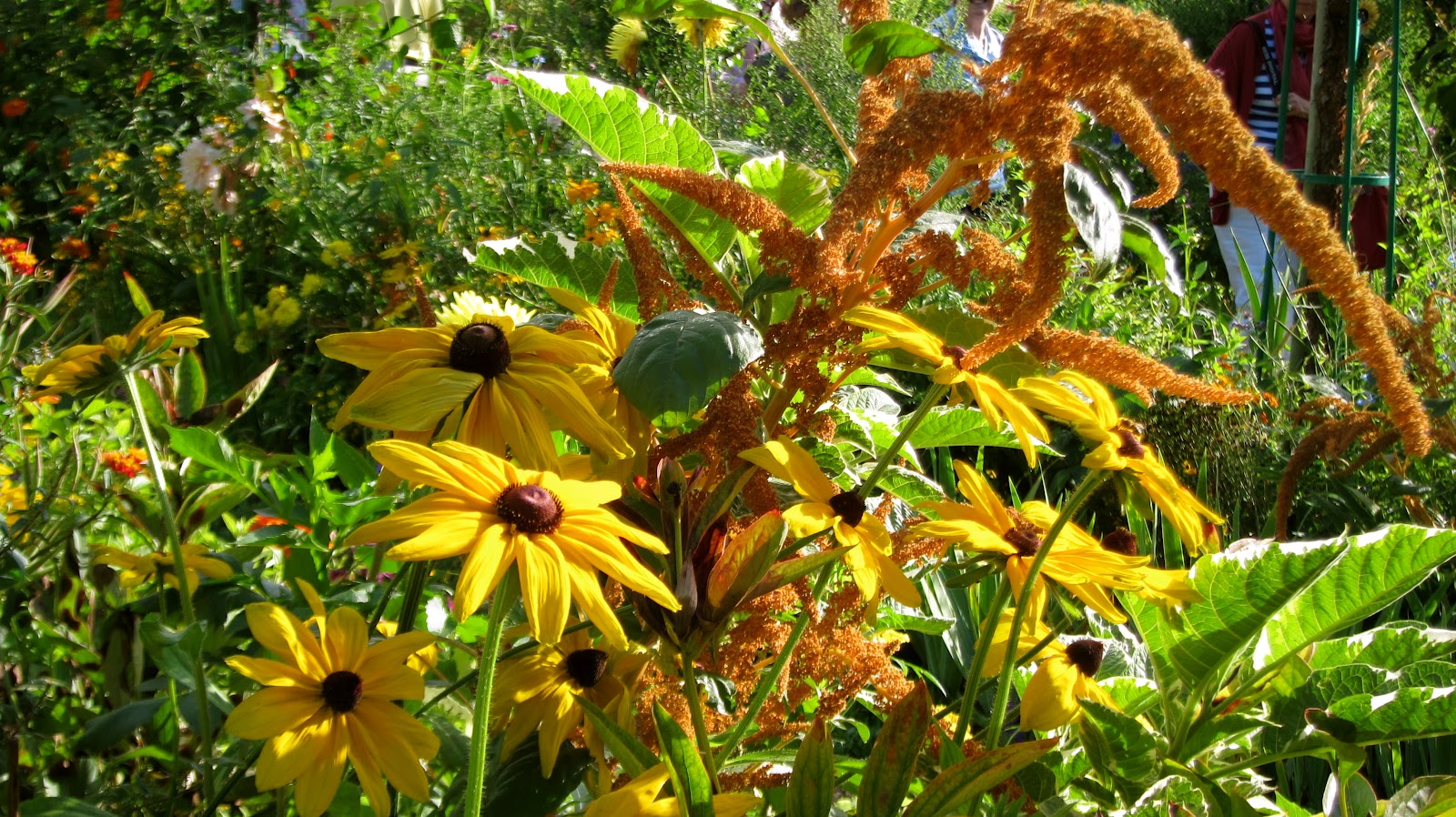
Of course, it was the gardens that inspired many of his paintings and I can certainly understand why!  Come with me on a gentle stroll amongst the flower gardens and the ponds ....


Monet didn't particularly like organized gardens and the gardens still remain somewhat haphazard - in a most-inviting way!


It's the last part of the season for the water lilies to bloom and, according to a passer-by that I overheard, they bloom in the afternoon.  Since I was there first thing in the morning, I missed the blooms - but, happily, I think I missed the masses of tourists, too.  A welcome trade-off for me!


Surely, all the reflections off the water inspired his style of painting.  And it's not hard to figure out where Monet's love of color came from.... 


The house and gardens are open 7 months out of the year and, no matter what time of the year you visit, there is an array of breathtaking color and variety of flowers.  


Departing from Monet's house and garden, I meandered through the sleepy village on my way back to the bus.  Seems everyone wants to keep up with the Monets with their beautiful gardens and flower boxes and


even this mail box! 


Monday, August 8, 2011

Hampton Court - the quaint little home of Henry VIII.

We recently visited Hampton Court Palace, the stately palace of Henry the VIII.  It's very easy to get to from London - we took a bus and got there in less than an hour.  It's located in Surrey, 13 miles west of London on the north side of the River Thames.


It was originally built by Cardinal Thomas Wolsey in 1514, Henry VIII's lord chancellor, for himself but when the cardinal opposed the king's request for a divorce from Catherine of Aragon, the king was not a happy camper and nabbed Hampton Court for himself.  I believe there's a lesson there!  It was a royal residence from 1525 to 1760.  It was pretty much abandoned after that until Queen Victoria opened it to the public in 1838.


The Tudor kitchens are amazing!  There are over 50 rooms that were used in the preparation of food for all the feasts plus there were over 1200 people living in the household of Henry VIII that had to be fed on a daily basis.


As you can see, "pies" have been around for a long time.  These are meat pies (I guess that's where our "pot pies" came from) and, traditionally, the crust was made from flour and water.  It's sole purpose was to hold the stew inside and wasn't meant for eating.  After it was cooked, they took a knife and sliced the top off, then ate out of it as if it were a bowl.  There are still meat pies sold all over England now.  I had one once and it was really tasty but the crust was good, too, so I ate it!


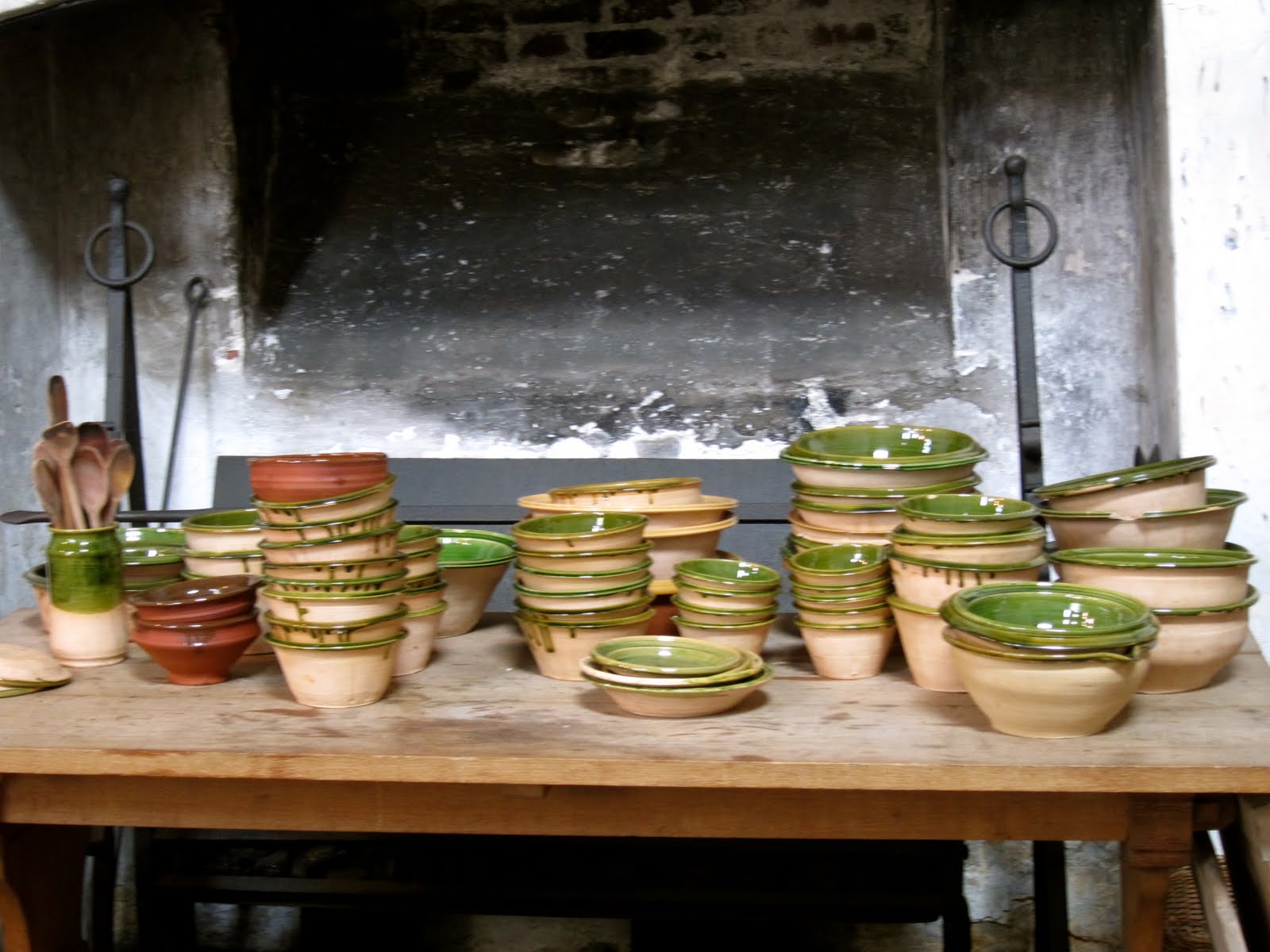
Pretty pottery.


Look how big this fireplace is!  The racks that you see there are designed to hold a spit for roasting meats.


I loved this pot.  I wanted to buy one like it and plant some flowers in it but it wasn't for sale and it wouldn't fit in my bag.  Off with my head!


William III had additional rooms built during his reign at the end of the 17th century.  This was his magnificent bed chamber and


this was what he looked at each night painted on the ceiling above his bed.  I guess it was a good reminder for him to say his prayers.


This dining room in the King's Apartments was a little more my style.


The William III's private garden has been restored to the way is was in 1702.


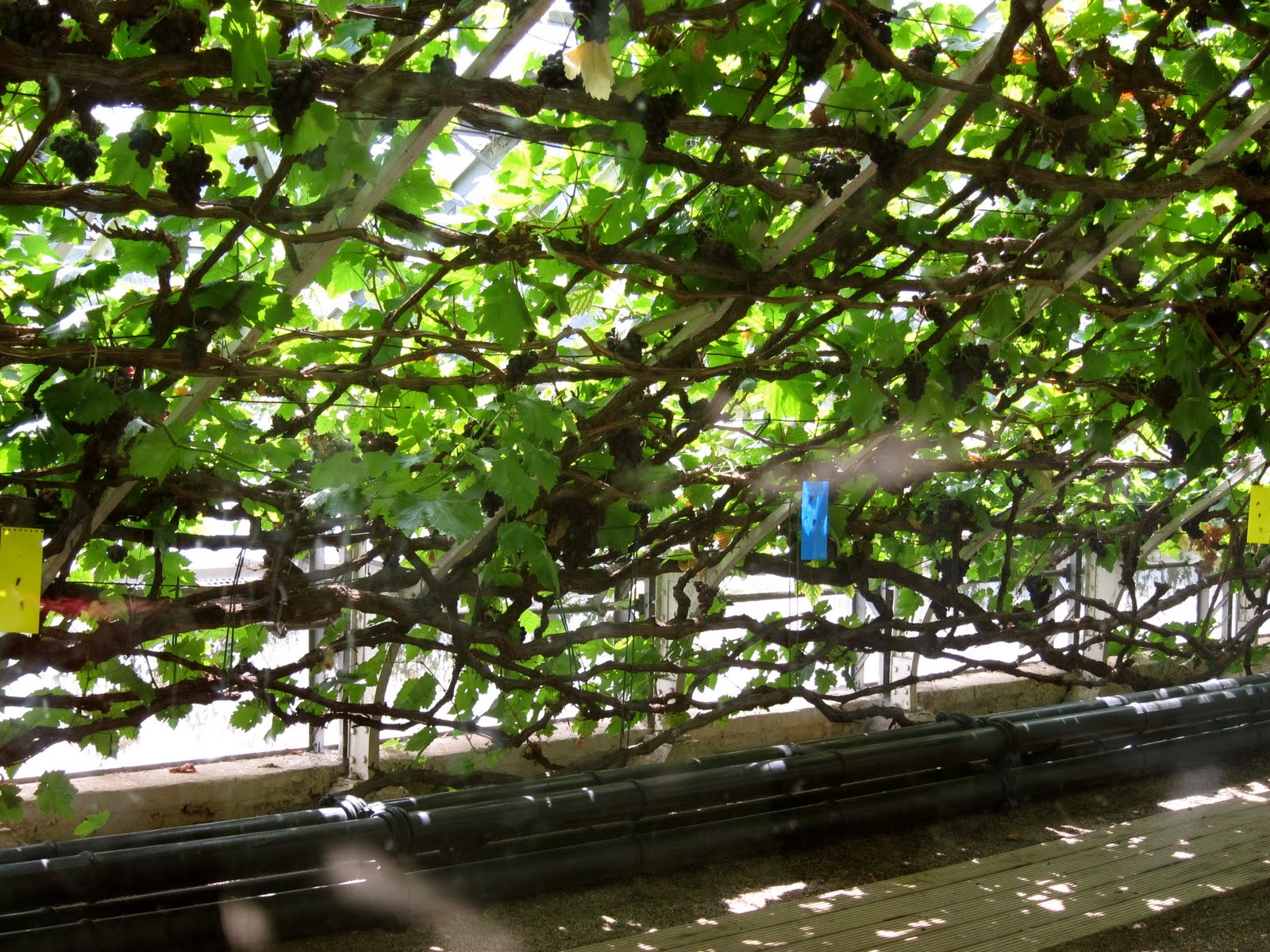
The Great Vine was planted in 1768 and is the oldest known vine in the world!  It still produces between 500 to 700 pounds of grapes each year, which are harvested at the end of August and sold to the shops in the palace.


The Pond Gardens

After living here for a year and seeing and hearing about so much English history, I still find it difficult keeping all the kings and queens straight.  David Phillips, who is an amazing tour guide that the American Women's Club of London uses frequently for their tours, told us a little ditty that he learned while growing up.  He says that all the English school kids learn this and I thought it was very clever:

Willie, Willie, Harry, Steve,
Harry, Dick, John, Harry Three,
One, Two, Three Teds, Richard Two,
Henry Four, Five, Six, then who?
Edward, Edward, Dick the Bad,
Henry, Henry, Ned the Lad,
Mary, Bessie, James the Vain,
Charlie, Charlie, James again,
William and Mary, Anna Gloria,
Four Georges, William and Victoria,
Eddie Seven, Georgie Five,
Eddie, George and Liz alive...

and that's 1,000 years of English history in a nutshell.