
Continuing on our excellent adventure, we employed the services of San Sebastian Foods for food and wine tours while in San Sebastian. This city is reknowned for it's cutting edge food and for it's unique Basque culinary culture.

I guess what was most striking to me was the prevalence of "pinxtos" restaurants. What is a pinxto (there's that pesky "x" again), you may ask? Basically, it's the Basque version of tapas - small, practically bite-sized culinary delights. Pinxto is pronounced as "pink show." San Sebastian has hundreds of these types of restaurants/bars - even ones that serve breakfast, pinxto-style.


So, it's much like bar hopping - no, it IS bar hopping. If you're smart, you hop into the establishments that are bustling with locals - they obviously have the best food! The bars are lined with a variety of pinxtos, you pick up a plate and choose what looks best to you. They charge per pinxto. The hard part is choosing because it all looks good. You have to pace yourself, though, because you must move on

to the next pinxto bar. The pinxto selection is different in each one so you don't want to fill up in the first one.

Because of the location of S. S., seafood is abundant and is a large part of the Basque diet. Anchovies play a big role in some of the pinxtos. Before you say "yuk," I should remind you that these aren't your typical canned anchovies. These are fresh from the sea and I can tell you it makes a huge difference in the taste. They're not fishy tasting and not nearly as salty as the canned ones.

Quite simple really - some mild peppers, a slice of fresh anchovy and an olive. Delicious - and pretty!

Here's another anchovy pinxto: fresh crusty bread topped with huge anchovies and - get this - blueberries! Sounds weird, I know, but it was my favorite!

Of course, you have to have something to complement the taste and that could be a glass of wine or

some cider. That's NOT apple cider but a light-tasting cider beer. This bartender's job is easy as all he has to do is line up the glasses.

These pinxtos are little sandwiches with another Spanish delicacy, Iberico ham, on the top.

Towards the end of the evening, our group ended up going to another beautiful restaurant for a final pinxto and glass of wine. (This guy acts like he owns the place!)

Several members of our group were Norwegians and this one, in particular, was quite a character. His name is Swein and, believe it or not, he is a butcher! We learned that the Norwegian word for "cheers," is "skol." We were saying that a lot by that time of the evening!

Another evening was spent touring the Rekondo wine cellar, which boasts having over 150,000 bottles of wine! The tome of a wine list has over 4,000 different wines to choose from.

The vast private collection includes vintage Mouton Rothschilds dating back to the late 1800s.

Martin, the restaurant sommelier, is passionate about the wine.

You can't visit this part of Spain without tasting the Rioja for which they are famous.

On to take a peek at the colorful food market where the Spaniards have a plethora of fresh foods to select from each day.

Ham, the king of all Spanish foods and

lots of fresh fish, a Basque favorite.

One evening, we splurged and treated ourselves to dinner at Arzak, one of 3 Michelin 3-star restaurants in San Sebastian and described by some as the best restaurant in the world. This city of 180,000 people has more Michelin stars per inhabitant than any place on earth. Fifteen, to be precise. That means one star for every 12,000 inhabitants!

Our reservation was at 8:45 - the earliest reservation possible. Once again, late night eating is definitely part of the Spanish culture. By the time we walked out of the restaurant that evening, it was almost 1:00 a.m. We couldn't believe we had been there for 4 hours!

The time flew by because not only were we being fed but we were entertained by each course that came out. Rex and Tom did the "tasting" menu, which meant quite a few courses. Karren and I opted for fewer courses but, by no means less exotic and mind-blowing.
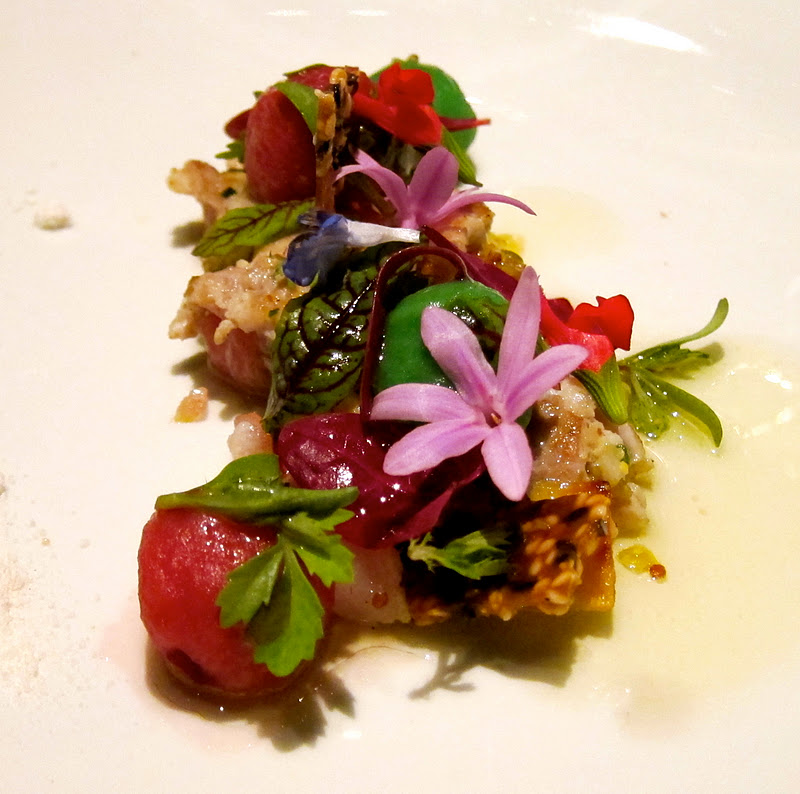
Every dish was a work of art and

was delicious, too.

Lemon, prawns and patchouli.

Pigeon with orange and corn

"Playing marbles with chocolate." This was my dessert selection and I have to admit I was a little wary of choosing an ice cream made with basil and mixing it with chocolate. It surprised me and soon I couldn't get enough of it. Exquisite!

This sauce grew before our eyes!

Blackberry and raspberry tree.

Can you guess what "ferreteria" means in Spanish? Hardware store! Yum - sweet nuts and bolts. Who ever thought up that idea?

One of the highlights of the evening was the opportunity to meet Elena Arzak (pictured) and her father, Juan Mari Arzak, founder of the restaurant. They work as a duo and, in Elena's words about her philosophy towards the food they serve, "We create an author’s cuisine: a Basque cuisine with research, innovation and a desire to be avant-garde, without turning our backs on local traditions." In my opinion, they have succeeded!


